Life in Malta · · 4 min read
Malta Budget 2027: what changes for locals, residents and tourists
Malta Budget 2027 was presented in Parliament on 26 October 2026, and it lands very differently depending on who you are. Maltese and EU citizens get higher pay and lower tax. Non-EU workers on a permit get new fees and lose some free services. Tourists pay more to stay. Here is each group's list, with the numbers. These are announcements, not law yet: the dates marked to be confirmed haven't been fixed.
Locals: Maltese and EU citizens
- COLA, the yearly cost-of-living adjustment, is €6.41 a week. Without the energy subsidies it would have been about €18.
- The minimum wage goes up €10.41 a week, COLA included.
- No income tax for minimum-wage earners or pensioners: the tax bands move so that neither pays.
- A €1,000 tax-free bonus, paid in the first three months of 2027, for workers earning €12,000 or more (less, pro rata, below that). It covers employees, the self-employed, part-timers and working pensioners. It's for Maltese nationals, EU citizens and long-term residents.
- Pensions go up €10 a week, COLA included, plus an extra €21.53 a week for every pensioner from 2027.
- Families: the family tax cuts of recent budgets carry on.
- Energy and fuel prices stay frozen, backed by about €400 million in subsidies next year.
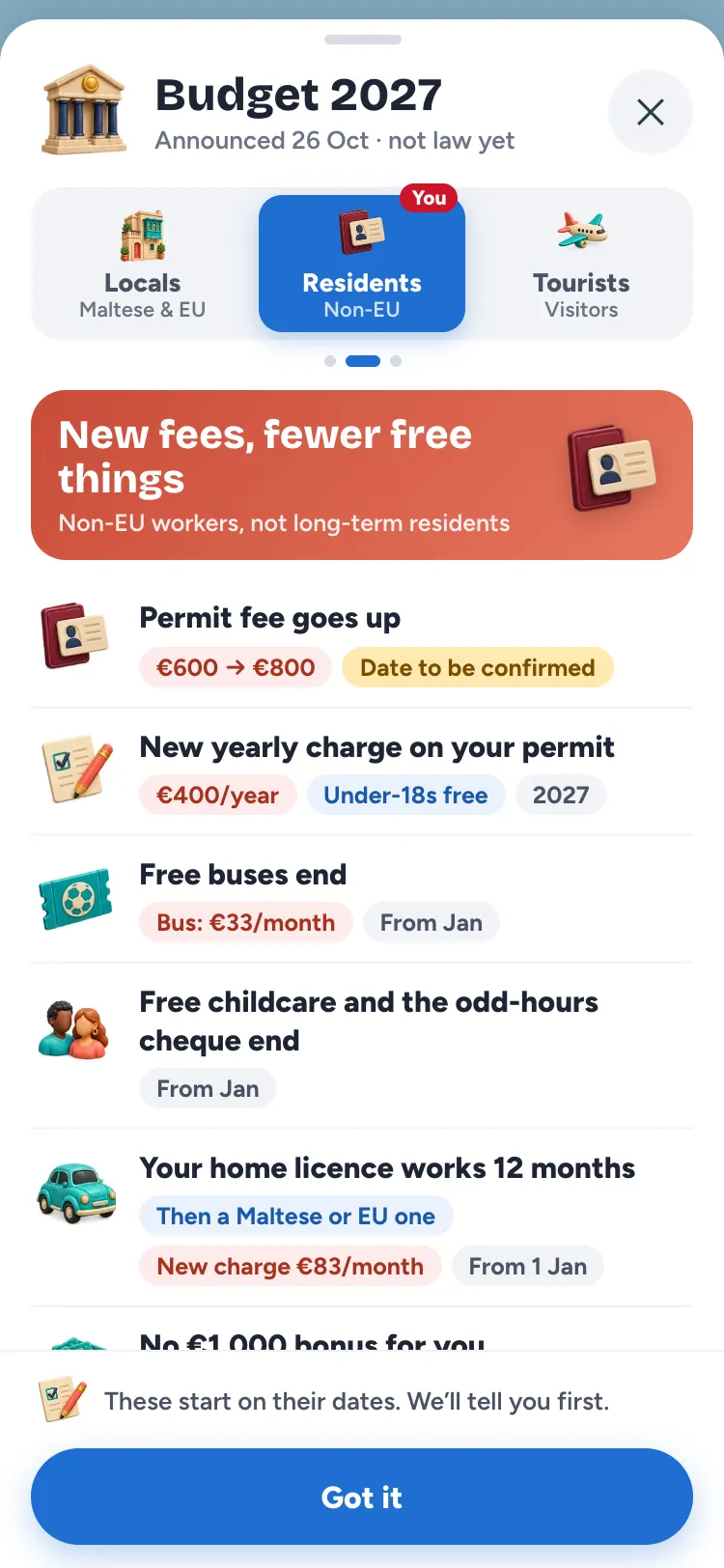
Residents: non-EU workers on a permit
This is the group the budget asks most of. Here, "third-country nationals" means non-EU workers who aren't long-term residents.
- The single permit fee for a new application goes from €600 to €800. Date to be confirmed.
- A new €400 a year when you apply or renew, paid by you, not your employer. Under-18s don't pay it.
- Free buses end from January for non-EU workers who aren't long-term residents. A monthly bus pass costs around €33. See how the tallinja bus works in the game.
- Free childcare and the cheque for odd working hours end on the same rule.
- Driving: a licence from home works for 12 months after you arrive, then you need a Maltese or EU one. Category B and B1 licences issued or renewed from 2027 carry a new €83 a month charge. UK, Australian and UAE licences are exempt, and so are EU/EEA citizens and long-term residents.
- No €1,000 bonus, unless you're a long-term resident.
Pay rises, the higher minimum wage and the frozen energy prices still count for you.
Tourists
- The eco-contribution goes from €1.50 to €8 per person per night in hotels from 1 January, up to €64 a stay. Short-let flats are €10 a night, up to €80. It's for visitors 18 and over, and stays at English-language schools are exempt.
- Comino's Blue Lagoon gets a €5 charge. Date to be confirmed.
- Cruise passengers who get off in Malta and back on the same ship pay €10. Date to be confirmed.
- The fast ferry to Gozo costs tourists €3 more a trip. Details to be confirmed.
In Malta Living
Malta Living is a life game set on this island, so the budget is in it too. When you next open the game, a card shows the three numbers that matter to you, and a sheet with three tabs (Locals, Residents and Tourists) shows the rest. It opens on your tab, whether you started as a local, on a work permit or as a tourist. If you haven't chosen yet, moving to Malta in the game explains the three ways in.
Nothing changes in the game today. Each rule starts on its real date, and we'll tell you in the game before it does: the permit fees in a resident's papers, the bus fares, the eco-tax in hotels, the Comino charge, the ferry. Planning a career while you wait? Jobs and careers has the ladders, and the Malta life simulator guide has everything else. Or just play Malta Living free.
Sources: the Malta Independent's live blog and MaltaToday's live coverage of the speech, and Newsbook on the energy subsidy. The Ministry for Finance's full documents weren't online when we wrote this. We'll update the post when they are.
Questions people ask
When was Malta Budget 2027 presented?
On Monday 26 October 2026, in Parliament. Most measures start in 2027; some dates, like the Comino and cruise charges, are still to be confirmed.
Do third-country nationals get the €1,000 bonus?
No. It goes to Maltese nationals, EU citizens and long-term residents earning €12,000 or more, pro rata below that, paid in the first quarter of 2027.
How much is the eco-contribution for tourists in 2027?
€8 per person per night in hotels, up to €64 a stay, and €10 a night in short lets, up to €80, from 1 January 2027. Under-18s don't pay.
Does the budget change anything in Malta Living today?
Not yet. The game shows what was announced, and each rule starts on its real date. We'll tell players before it does.